


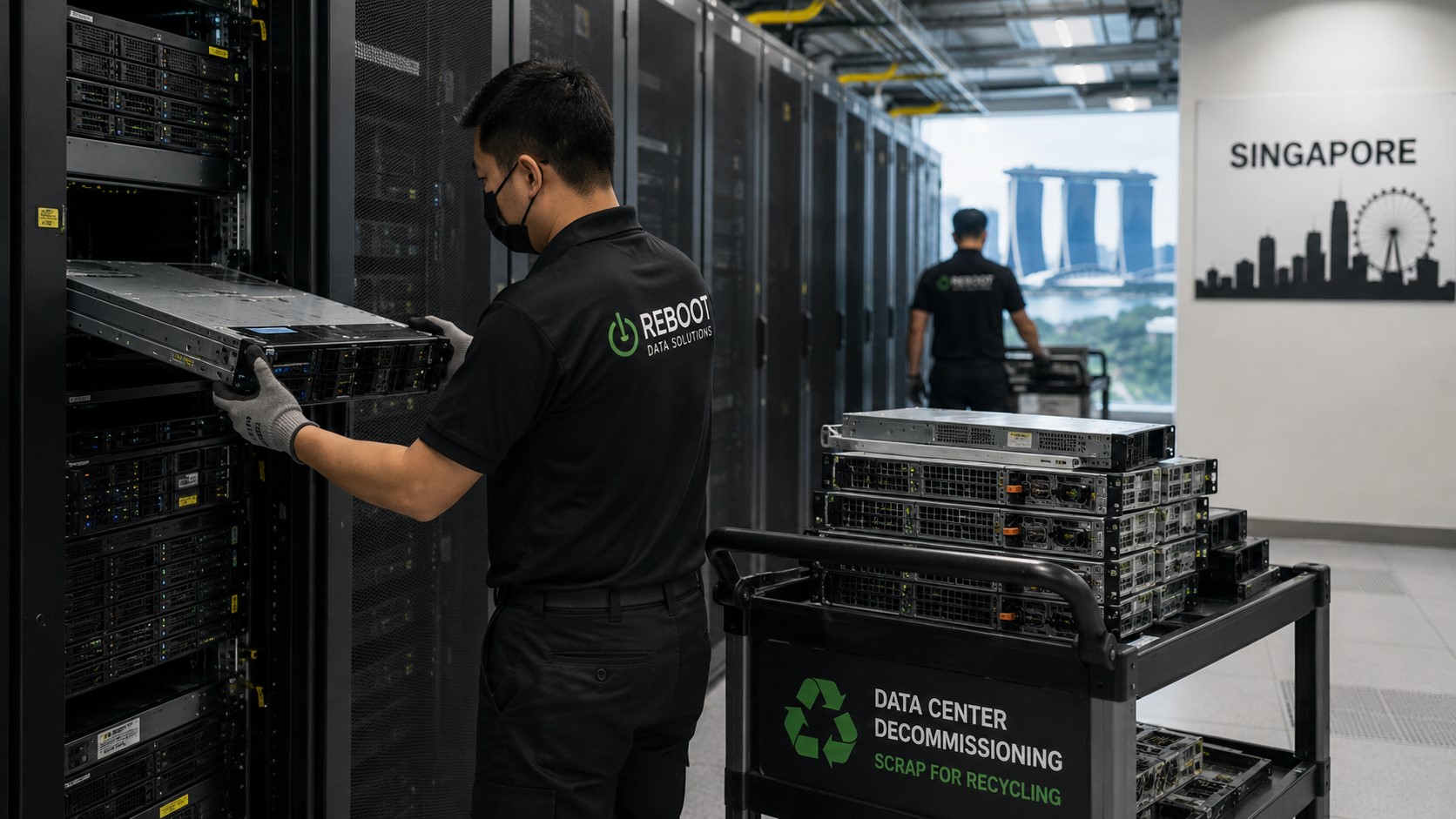
29 Jun Data Center Decommissioning Scrap Collection in Singapore
Decommissioning a data center is not as simple as switching off the servers and calling it done. Businesses across Singapore regularly face the same challenge: a room (or floor) full of obsolete hardware, drives loaded with sensitive data, and no clear plan for what comes next. Get it wrong and you risk a data breach, a compliance headache, or simply leaving money on the table from equipment that had real scrap value.
This article walks you through exactly how data center decommissioning scrap collection works in Singapore — what equipment can be collected, how the process runs from audit to pickup, and what you need to do to protect your business every step of the way.
Ready to Sell? List Your Items Here: https://karung-guni.com/karung-guni-sell/
What Is Data Center Decommissioning?
Data center decommissioning is the structured process of retiring, removing, and responsibly disposing of end-of-life IT infrastructure. This covers everything from physical servers and networking gear to power systems and cooling units.
It is not just an IT task. It involves coordination between your IT team, facilities management, and whoever handles disposal — whether that is an ITAD (IT Asset Disposal) provider, a licensed scrap collector, or both. Done properly, it protects your data, keeps you compliant with Singapore regulations, and can recover some commercial value from the hardware you are retiring.
What Data Center Equipment Can Be Collected as Scrap?
Most businesses are surprised by how broad the category actually is. If it ran your data center, there is a good chance it qualifies for scrap collection.
Servers and Rack Equipment
Rack servers, blade servers, and tower servers are among the most commonly collected items. Even machines that are years past their useful life retain value — either as functional units for resale or as a source of metals including aluminium, steel, and copper used in internal components. The brand, age, and physical condition all affect what you will get, but very little is truly worthless at the metal level.
Networking and Telecoms Hardware
Switches, routers, firewalls, patch panels, and structured cabling all qualify. Copper-rich cabling in particular tends to carry solid scrap value. Older telecoms racks that have been sitting unused since a migration are worth including in your collection rather than leaving to gather dust.
Storage Devices and Drives
This is where things get more nuanced. Hard drives (HDDs), solid-state drives (SSDs), and enterprise storage arrays such as NAS and SAN units can all be collected — but what happens to them depends on whether certified data destruction has been completed first. Functional, securely wiped drives may have resale value. Drives that cannot be verified as clean should be physically destroyed before or during the handover process.
Power and Cooling Infrastructure
PDUs (power distribution units), UPS (uninterruptible power supply) systems, transformers, and CRAC (computer room air conditioning) units are often overlooked but can carry significant scrap value. Battery packs from UPS systems contain lead, which has active demand in the scrap market. Large cooling units often contain copper coils and aluminium components.
Monitors, Peripherals, and Accessories
Older monitors, KVM switches, cables, and rack accessories are also collectible. Their scrap value per unit is lower, but when you are clearing an entire data center, the volume adds up.

Ready to Sell? List Your Items Here: https://karung-guni.com/karung-guni-sell/
Why Proper Data Center Scrap Collection Matters in Singapore
Choosing the right approach to disposal is not just about convenience. There are real legal and financial reasons to do this properly.
Data Security and Compliance
Singapore’s Personal Data Protection Act (PDPA) places clear obligations on organisations handling personal data. If a decommissioned server or drive is improperly disposed of and data is later recovered, the consequences can include regulatory investigation and significant reputational damage.
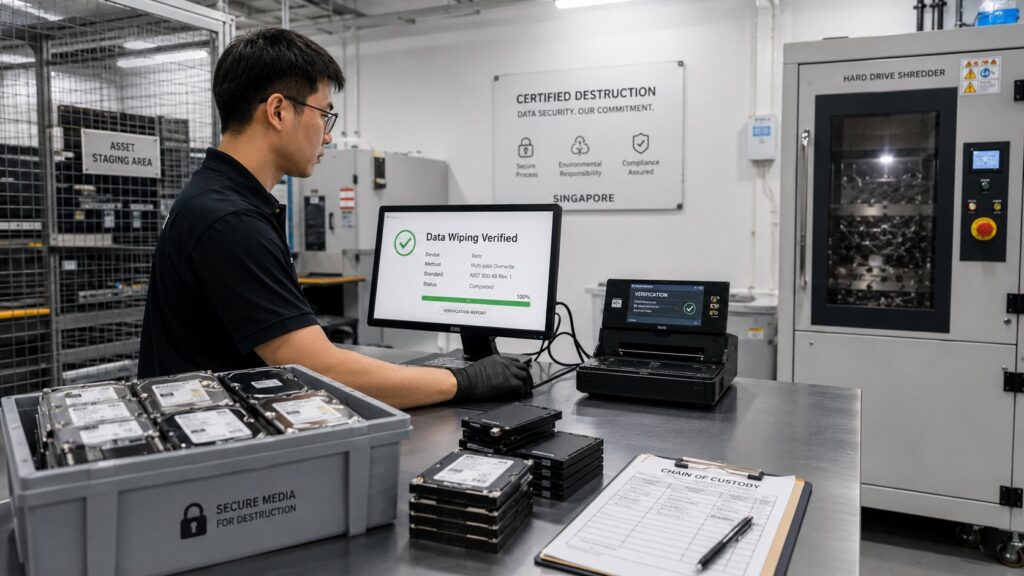
Before any equipment leaves your premises, ensure that all data has been destroyed using a recognised method — software wiping, degaussing, or physical shredding, depending on the media type. Crucially, ask your scrap collector or disposal partner for a data destruction certificate. This document confirms that the destruction was carried out and gives you a defensible record if your process is ever questioned.
Environmental Responsibility and E-Waste Regulations
Singapore operates an Extended Producer Responsibility (EPR) framework for e-waste, administered by the National Environment Agency (NEA). Businesses that dispose of IT equipment through unlicensed or informal channels risk non-compliance with these regulations.
Using a licensed scrap collector ensures that your equipment is processed through proper recycling and recovery channels. This matters not just for regulatory reasons but increasingly for corporate sustainability reporting as well.
Commercial Value Recovery
Properly managed scrap collection can return real value to your business. The metals in data center hardware — copper wiring, aluminium chassis, steel racks — are traded commodities. The scrap value will depend on the weight, composition, and current market rates, but a large decommissioning project can generate meaningful returns that offset some of your disposal costs.
Some equipment, if functional and wiped, may also qualify for resale rather than scrapping, further increasing the return.
How the Data Center Scrap Collection Process Works
A well-managed decommissioning follows a clear sequence. Skipping steps — especially around data and documentation — is where businesses tend to run into problems.
Step 1: Inventory and Asset Audit
Before anything is touched, document everything. Go rack by rack and catalogue each item by type, model, age, and condition. This serves two purposes: it gives you the information needed to assess scrap or resale value, and it establishes a clear chain of custody for data security purposes. If you have an existing asset register, check it against what is physically on the floor — the two rarely match perfectly after years of changes.
Step 2: Data Destruction
Data destruction must happen before equipment leaves your control. For most magnetic hard drives, degaussing followed by physical shredding provides the highest assurance. Software wiping to standards such as DoD 5220.22-M or NIST 800-88 is acceptable for drives that will be resold, but physical destruction is the safer choice for drives containing highly sensitive data.
SSDs require specific destruction methods — degaussing does not work on flash memory, so physical shredding is typically required. Confirm the destruction method with your provider and obtain a written certificate for each batch of drives processed.
Step 3: Scheduling the Collection
Once your inventory is complete and data has been handled, coordinate the logistics. A professional scrap collector should be able to accommodate large-volume pickups, including physical removal of rack equipment if required. Confirm in advance whether the collector handles dismantling, or whether your team needs to have equipment removed from racks before the collection date.
For large data centers, collection may be staged over multiple visits rather than completed in one day. Plan this with your facilities team to avoid disruption to any systems still in operation.
Step 4: Scrap Valuation and Payment
Scrap value is assessed based on equipment weight, metal content, and current market rates. For large lots, a reputable collector will typically conduct an on-site assessment or review photos and inventory lists before providing a valuation. Rates fluctuate with commodity markets, so the value at the time of collection may differ from earlier estimates. Clarify whether the valuation is fixed at assessment or adjusted on collection day.
Step 5: Responsible Disposal and Documentation
After collection, your equipment is sorted, with metals recovered and non-recyclable components disposed of through licensed waste streams. Ask your collector for a waste disposal receipt or documentation confirming how the equipment was processed. This record is useful for internal auditing, regulatory compliance, and sustainability reporting.
Ready to Sell? List Your Items Here: https://karung-guni.com/karung-guni-sell/
Common Mistakes to Avoid During Data Center Decommissioning
Most problems during decommissioning are avoidable. These are the ones that come up most often:
- Skipping the inventory audit. Without a proper asset list, you cannot track what was collected, verify scrap weights, or account for every device in your data security process.
- Disposing of drives without certified destruction. A standard factory reset is not sufficient for enterprise drives. Assume data can be recovered unless it has been physically destroyed or wiped to a verified standard.
- Using unlicensed or informal collectors. Collectors who cannot provide documentation — for data destruction or waste disposal — leave your business exposed on both data security and environmental compliance fronts.
- Failing to separate resaleable equipment from scrap. Some equipment may have significantly more value as a working unit than as metal. A quick check against current secondhand IT market prices before handover can make a noticeable difference.
- Underestimating the time required. A full data center decommission — including audit, data destruction, and logistics coordination — typically takes weeks, not days. Starting the planning process late creates pressure that leads to shortcuts.
Tips for a Smooth Data Center Scrap Collection
A few practical steps make the whole process significantly easier:
- Start your asset audit at least four to six weeks before the target decommission date, particularly if you are running a large environment.
- Keep a separate list of equipment you suspect may have resale value, and get it assessed before assuming everything goes to scrap.
- Confirm in writing — before any handover — what data destruction method will be used and what documentation you will receive.
- Check whether your scrap collector can provide a formal waste disposal receipt, and request this as a standard part of the engagement.
- Brief your facilities team on access requirements, especially if racks or large cooling units need to be removed from raised flooring or contained spaces.
Why Choose Karung Guni Singapore for Data Center Scrap Collection
For businesses in Singapore looking to manage data center scrap collection without the headache of coordinating multiple vendors, Karung Guni Singapore handles bulk B2B pickups across a wide range of IT and industrial equipment. Whether you are clearing a server room, a full data center floor, or retiring individual equipment lots, the team can assess your inventory and arrange collection directly.
If you are at the planning stage and want to understand what your equipment is worth before committing to a disposal approach, you can get in touch through karung-guni.com to discuss your requirements and arrange an assessment.
Key Takeaways
- Data center decommissioning involves more than removing hardware — it requires a documented audit, certified data destruction, and compliant disposal.
- Servers, networking equipment, storage devices, power systems, and cooling infrastructure all qualify for scrap collection in Singapore.
- Singapore’s PDPA and NEA e-waste regulations make proper data destruction and licensed disposal a legal and compliance requirement, not just a best practice.
- Scrap value depends on equipment weight, metal content, and market rates at the time of collection — some functional equipment may be worth more as resale.
- Using a licensed scrap collector who provides documentation protects your business on data security, regulatory compliance, and internal audit fronts.
- Starting the process four to six weeks before your planned decommission date gives you enough time to do it properly.
Frequently Asked Questions
What types of data center equipment can be collected as scrap in Singapore?
Most data center hardware qualifies, including rack and blade servers, networking equipment (switches, routers, patch panels), storage systems, UPS units, PDUs, CRAC cooling units, and structured cabling. Peripheral equipment such as monitors and KVM switches can also be included. The scrap value varies by equipment type, weight, and metal content, but very little is worth excluding from a collection assessment.
How is data destroyed before data center equipment is handed over for scrap collection?
Data destruction methods include software wiping (for drives that will be resold), degaussing (for magnetic HDDs), and physical shredding (for HDDs and SSDs requiring the highest assurance level). The appropriate method depends on the sensitivity of the data and the type of storage media. Always request a written data destruction certificate from your provider — this is your record that destruction was completed before the equipment left your premises.
Does data center scrap have monetary value, and will I be paid for it?
Yes, in most cases. Data center hardware contains copper, aluminium, steel, and other recoverable metals that have active scrap market value. The amount you receive depends on equipment volume, metal content, and commodity prices at the time of collection. Some functional equipment may also qualify for resale at a higher value than pure scrap. A reputable collector will provide a valuation before or at the point of collection.
How long does it take to arrange a data center scrap collection in Singapore?
The logistics of a single pickup can typically be arranged within a few days once your equipment is ready. However, the full decommissioning process — including audit and data destruction — usually takes several weeks for a large environment. It is advisable to contact a collector early in your planning process so that collection can be scheduled to align with your data destruction timeline.
Do I need to dismantle the equipment myself before collection?
Not necessarily. Many professional scrap collectors, including those handling large B2B volumes, can manage the removal of rack-mounted equipment as part of the collection service. Confirm this in advance when scheduling, particularly if equipment is mounted in tall racks, installed under raised floors, or located in areas with restricted access.
Conclusion
Data center decommissioning is a process with real stakes — for your data security, your regulatory standing, and the commercial value you recover from years of hardware investment. The businesses that handle it well are the ones that plan ahead, document everything, and work with a collector who can provide the paperwork to back it up.
If you have a decommissioning project coming up in Singapore, the earlier you start the planning, the more options you have. To arrange a data center scrap collection or discuss your equipment with a team that handles bulk B2B pickups regularly, contact Karung Guni Singapore at karung-guni.com and request a collection assessment.
Ready to Sell? List Your Items Here: https://karung-guni.com/karung-guni-sell/
No Comments