


27 Jun Professional E-Waste Collection for Your Office in Singapore
Most Singapore offices have one: a storeroom, cabinet, or neglected corner slowly filling with outdated laptops, dead printers, tangled cables, and phones nobody uses anymore. It builds up quietly — one hardware refresh at a time — until the pile becomes impossible to ignore.
The problem is not just the clutter. Old office electronics sitting in storage create real data security risk. Disposing of them through general waste channels is non-compliant with Singapore’s e-waste regulations. And simply handing devices to staff or a passing collection service without due diligence leaves your business exposed.
This article explains how professional office e-waste collection works in Singapore, what to look for in a provider, how to prepare your devices, and what happens after the collection is done.
Ready to Sell? https://karung-guni.com/karung-guni-sell/
Why Office E-Waste Is Different From Household Disposal
Disposing of a personal laptop or old mobile phone is relatively straightforward. Office e-waste is a different matter.
The volumes are larger, the logistics are more complex, and the stakes around data security are higher. A single hardware refresh cycle can generate dozens of laptops, monitors, and peripheral devices — all potentially containing sensitive business data, employee records, or client information.
There is also a regulatory dimension. Under Singapore’s Extended Producer Responsibility (EPR) framework, businesses are expected to handle regulated electronic products responsibly. Tossing equipment into general waste bins is not compliant and is not a sustainable solution for a company that takes its operational responsibilities seriously.
Professional office e-waste collection exists to address all of this in one coordinated process.
What Counts as Office E-Waste?
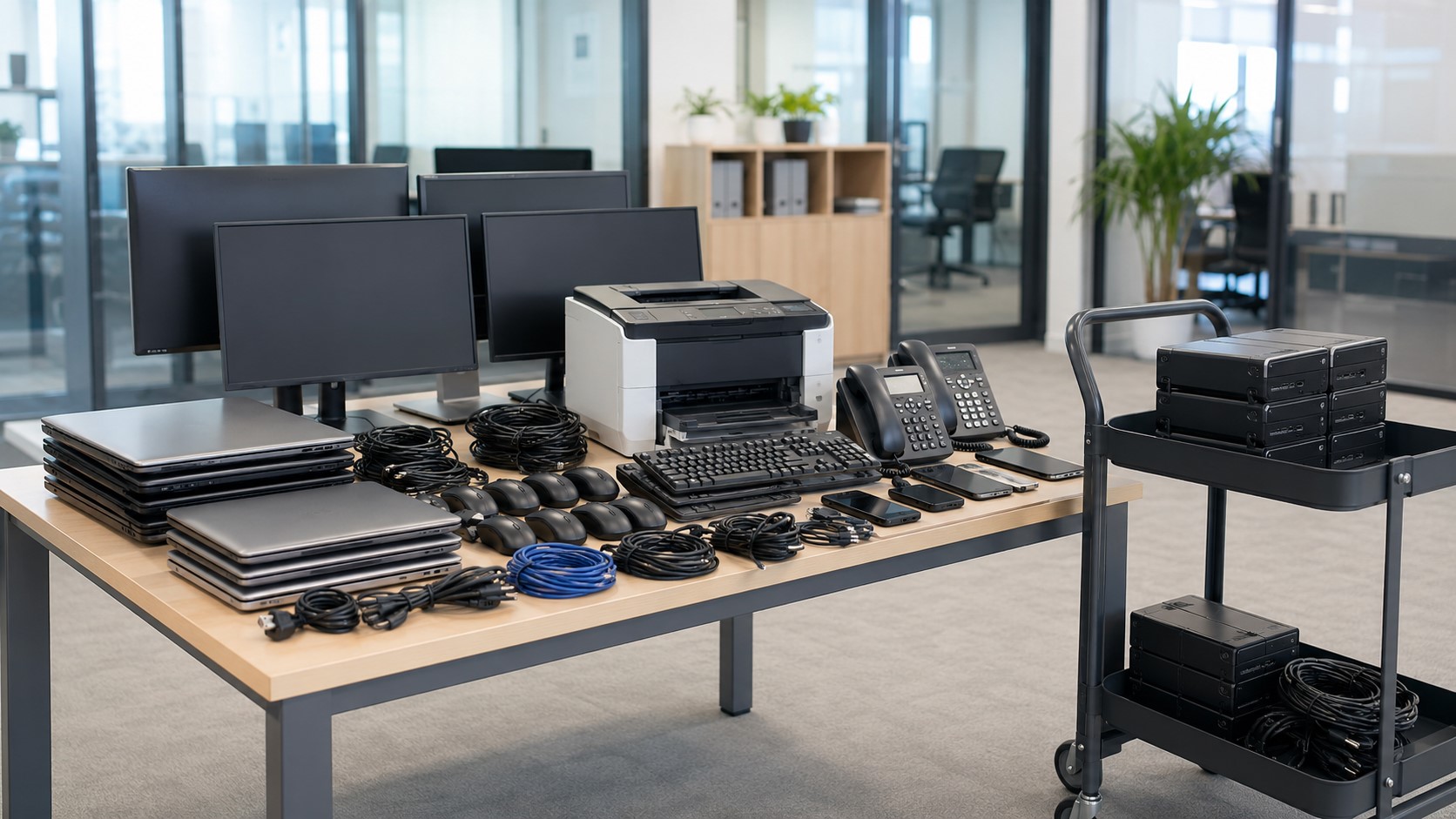
Before booking a collection, it helps to know which items typically qualify. Most professional services in Singapore handle:
- Computing equipment: Desktops, laptops, servers, tablets, and workstations
- Display devices: LCD monitors, projectors, and screens
- Printing and imaging: Printers, copiers, scanners, and fax machines
- Telecommunications: Office phones, mobile phones, and video conferencing units
- Networking hardware: Routers, switches, modems, and access points
- Power equipment: UPS units and power strips
- Accessories and peripherals: Keyboards, mice, external drives, cables, and chargers
- Audio-visual equipment: Speakers, headsets, and presentation systems
Some items may require special handling or separate arrangements — older CRT monitors, standalone batteries, and fluorescent lamps, for example. Confirm with your provider during the booking stage if you have anything unusual.

Ready to Sell? https://karung-guni.com/karung-guni-sell/
Singapore’s E-Waste Regulations — What Offices Should Know
Singapore introduced a mandatory e-waste management system under the Resource Sustainability Act, administered by the National Environment Agency (NEA). The framework places responsibility on producers and retailers of regulated electrical and electronic equipment, and sets expectations for how end-of-life devices should be handled.
For businesses, this means:
- Regulated devices (including ICT equipment, household appliances, and batteries) should not be disposed of in general waste.
- Using a collection service that channels devices to licensed recyclers keeps your organisation on the right side of these expectations.
- Some businesses with higher volumes or specific device types may have additional obligations — the NEA website provides current guidance.
This is not a reason to panic. For most offices, working with a professional collection service that operates within Singapore’s regulatory framework is sufficient.
Does Your Office Need a Certified Recycler?
You do not necessarily need to audit your provider’s certifications in detail, but you should be able to confirm a few basics:
- Does the provider have an established process for sorting, reusing, and recycling collected devices?
- Can they provide a receipt or documentation confirming the collection?
- Do they work with licensed downstream recyclers in Singapore?
If a provider cannot answer these questions clearly, that is a reasonable signal to look elsewhere.

Ready to Sell? https://karung-guni.com/karung-guni-sell/
What Professional Office E-Waste Collection Actually Involves
The process is more straightforward than most offices expect. Here is what a professional collection typically looks like from start to finish.
Step 1 — Audit Your Equipment
Before booking, take stock of what you have. You do not need a detailed asset register, but a rough count helps the provider send the right team with the right equipment.
Quick audit checklist:
- How many devices of each type?
- Are any items unusually large or heavy (e.g., servers, large printers)?
- Are devices stacked in storage or spread across floors?
- Is there lift access, a loading dock, or any access restrictions?
Even an approximate count makes the booking conversation more efficient.
Step 2 — Book a Collection
Contact your chosen provider with the following information:
- Office address and floor details
- Estimated volume and device types
- Preferred collection date and time window
- Any access requirements (security sign-in, parking restrictions, building passes)
A reputable service will confirm the booking promptly and give you a clear picture of what to expect on the day.
Step 3 — Prepare Devices for Handover
Data security before disposal is the office’s responsibility — unless you have specifically arranged for the provider to handle it.
Before the collection:
- Wipe or factory-reset all devices. For computers, use secure erasure software rather than simply deleting files. A standard deletion does not remove data from the drive.
- Remove SIM cards from mobile phones and tablets.
- Log out of all accounts — cloud services, email, business software.
- Remove external storage such as USB drives or SD cards.
If your office handles particularly sensitive data, ask your provider whether they offer certified data destruction and whether they supply a destruction certificate. This is worth confirming in writing before the collection day.
Step 4 — Collection Day
On the day, the collection team will:
- Arrive at the agreed time and check in with your contact
- Work through the items systematically, sorting as they go
- Pack or load equipment safely, including fragile screens and larger units
- Provide a handover receipt or documentation confirming what was collected
The process for a standard office volume typically takes between one and three hours, depending on quantity and access. Having a staff member available to assist with access and sign off the collection keeps things moving.
Step 5 — What Happens After Collection
Professional e-waste collectors do not simply truck devices to landfill. Items are assessed and directed to the appropriate end-of-life pathway:
- Functional devices in good condition may be refurbished and resold, extending their useful life.
- Partially functional devices are stripped for reusable components.
- Non-functional devices are broken down and materials — metals, plastics, glass — are recovered through licensed recycling channels.
This is the difference between responsible disposal and simply moving the problem elsewhere.

Ready to Sell? https://karung-guni.com/karung-guni-sell/
How to Evaluate an Office E-Waste Collection Provider
Not every service offering to “collect old electronics” operates at the same standard. When evaluating providers, look for the following:
Volume capability Can they handle the scale of your collection without difficulty? A service geared toward single-item household pickups may not be equipped for an office cleanout involving 50 laptops and a server rack.
Data security options Do they offer data destruction, and can they document it? Even if you wipe devices yourself, a provider that takes data handling seriously is a meaningful signal of overall professionalism.
Documentation Will they provide a receipt or handover record? This matters for your own records and for any future compliance queries.
Logistics flexibility Can they accommodate your building’s access requirements? Do they work within business hours or offer flexible scheduling?
Transparency about what happens next A professional provider will be able to tell you where collected items go. Vague answers about “recycling” without any specifics are worth probing further.
For offices in Singapore looking for a straightforward, professionally managed booking experience, Karung Guni Singapore (karung-guni.com) handles office e-waste collection at scale and can assist with the logistics of clearing both small batches and larger volumes.
Common Mistakes Offices Make With E-Waste Disposal
These are the patterns that create problems — often preventable ones:
- Letting devices accumulate for years because “there aren’t enough yet.” There is no ideal volume threshold. Arrange collection when devices are no longer in use.
- Disposing of electronics in general waste or recycling bins. Neither is appropriate for regulated electronic equipment in Singapore.
- Handing devices to staff without wiping them. Well-intentioned, but it transfers data security risk out of your control.
- Selling old devices without thorough data wiping. Resale value rarely justifies the risk of improperly wiped drives leaving the building.
- Not requesting any documentation from the collector. A receipt or handover record takes seconds to issue and provides important protection.
- Forgetting accessories. Cables, chargers, keyboards, and external drives are also e-waste. They tend to pile up in drawers and get overlooked.
- Assuming the IT team will handle it without a clear process in place. Assign ownership explicitly so nothing falls through the gaps.
How Often Should an Office Schedule E-Waste Collection?
There is no fixed schedule that works for every business, but a few natural trigger points work well:
- Quarterly reviews for offices with regular hardware turnover
- Hardware refresh cycles — whenever new devices are rolled out, old ones should be removed in the same process
- Office relocations or renovations — the move itself is the most practical time to clear equipment that will not be moving with you
- Lease renewals and end-of-tenancy — avoid the last-minute scramble by scheduling collection two to four weeks ahead
A practical approach is to designate an internal collection point — a labelled storage area where retired devices are placed as they leave service. When it reaches a meaningful volume, book a collection. This prevents both accumulation and panic disposal.
Key Takeaways
- Office e-waste involves higher volumes, data security responsibilities, and regulatory considerations than household disposal.
- Singapore’s NEA-administered EPR framework sets expectations for how regulated electronics should be handled at end of life.
- A professional collection service manages the logistics, documentation, and downstream recycling on your behalf.
- Data wiping is the office’s responsibility unless certified destruction is specifically arranged with the provider.
- Evaluate providers on volume capability, data security options, documentation, and transparency about where items go.
- Schedule collection at natural business milestones — hardware refreshes, office moves, or when your internal holding area reaches capacity.
Frequently Asked Questions
Do I need to wipe data from devices before office e-waste collection?
Yes — and it is best practice to do so regardless of which provider you use. A factory reset or secure erasure removes the most accessible data, but if your office handles particularly sensitive information, you should ask your provider whether they offer certified data destruction and whether a destruction certificate is available. Do not rely on simply deleting files, as this does not fully remove data from storage drives.
What types of electronics does professional office e-waste collection typically cover?
Most services cover computing equipment (laptops, desktops, servers), monitors, printers, copiers, phones, tablets, networking hardware, UPS units, and accessories including cables and chargers. Items requiring special handling — such as CRT monitors or standalone batteries — may need separate arrangements. Confirm with your provider during the booking stage if you have anything unusual.
Is it legal to throw office electronics in the general waste in Singapore?
Regulated electrical and electronic equipment should not be disposed of through general waste channels under Singapore’s Resource Sustainability Act and the NEA’s EPR framework. Using a professional collection service that channels devices to licensed recyclers is the responsible and compliant approach. For the most current regulatory guidance, refer to the NEA website directly.
How far in advance should I book an office e-waste collection?
For standard office volumes, two to five business days’ notice is typically sufficient. If your collection involves a server room, a full-floor clearout, or time-sensitive scheduling around a move or lease end, arranging it two to four weeks ahead gives both parties more flexibility and reduces the risk of delays.
Can old office equipment be resold rather than recycled?
In some cases, yes. Devices that are still functional or relatively recent may have refurbishment or resale value. Some professional collection services assess items on collection and direct usable equipment toward reuse rather than immediate recycling. If recovering value from older assets is a priority, raise this with your provider when booking — they can advise on whether any items in your collection qualify.
Ready to Clear Your Office E-Waste?
Managing office e-waste does not need to be complicated. With a clear picture of what you have, a provider you can trust, and devices prepared for handover, a professional collection can be arranged and completed with minimal disruption to your working day.
The risk of leaving old electronics in storage — data exposure, wasted space, and regulatory non-compliance — is rarely worth the inertia.
Karung Guni Singapore provides professional e-waste collection for offices across Singapore. Whether you are clearing a single storeroom or managing a full office transition, their team handles the logistics so you do not have to. Visit karung-guni.com to arrange a pickup or find out more about what they collect.
Ready to Sell? https://karung-guni.com/karung-guni-sell/
No Comments