


06 Jul Sell Copper Wire Scrap for Instant Cash Today: A Singapore Seller’s Guide
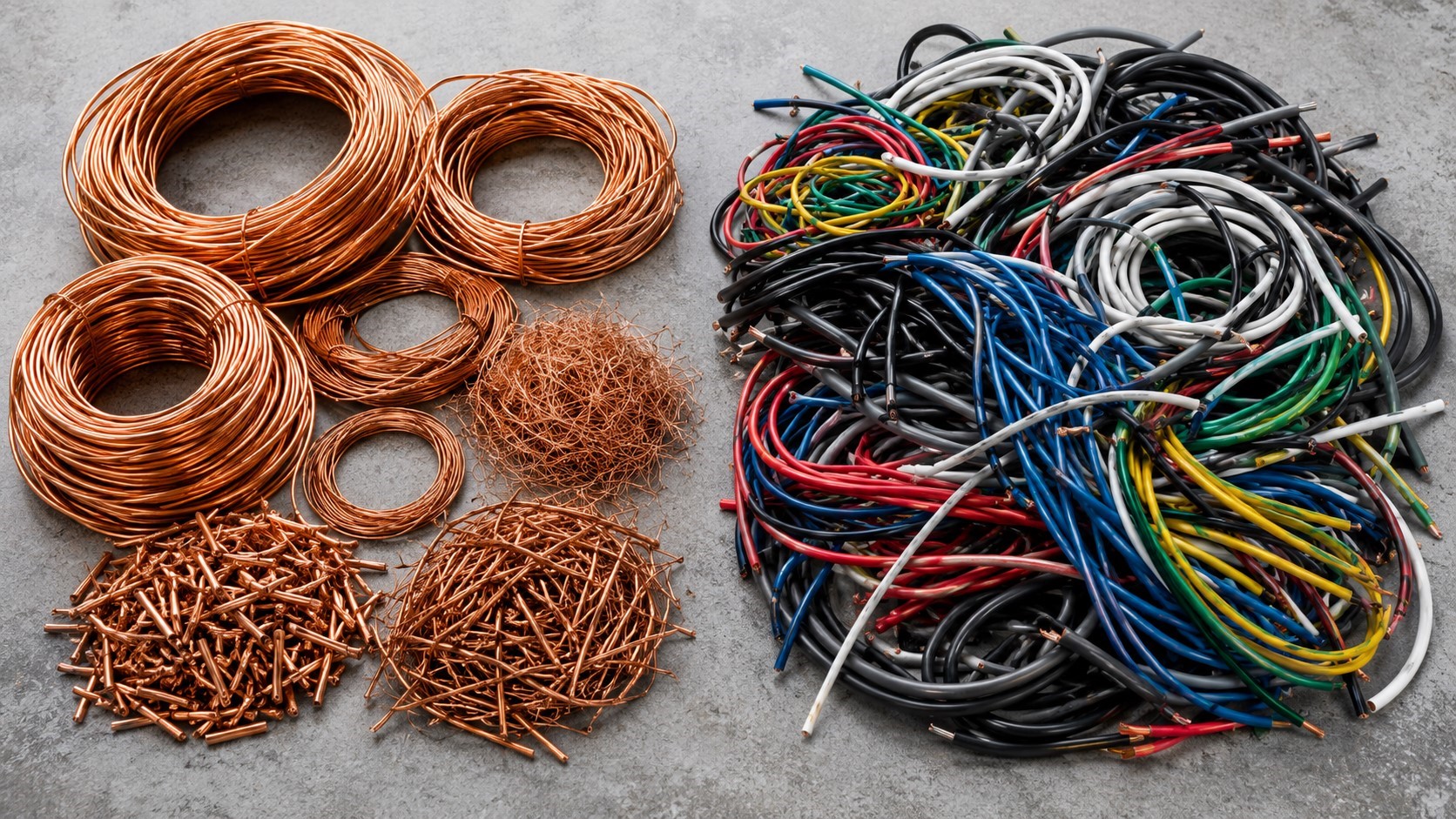
If you’ve got a coil of copper wire sitting in a storeroom, a bag of offcuts from a renovation, or a bundle of old cabling pulled out during an office refit, here’s the short answer: yes, you can turn it into cash today, and you don’t need to haul it anywhere yourself. What you actually get paid depends a lot on the grade and condition of the wire. A dealer that collects from your doorstep and pays on the spot, like Karung Guni Singapore, takes care of the most annoying part of the whole thing, which is figuring out how to get a heavy bag of wire from your unit to a scrapyard.
The rest comes down to understanding what you actually have, because “copper wire” isn’t one product with one price. It’s a handful of different grades, and knowing which one you’re sitting on is the difference between a decent payout and a disappointing one.
Sell at Karung-guni: https://karung-guni.com/karung-guni-sell/
What Determines the Price of Your Copper Wire
Copper scrap prices follow the global copper market, which gets set daily on the London Metal Exchange (LME). Dealers in Singapore quote against that benchmark, then adjust down depending on how much work your specific wire needs before it can be sold on to a smelter.
That second part is where most of the variation comes from. A scrap dealer isn’t paying you for “copper.” They’re paying you for copper they can resell with as little extra work as possible. The cleaner and purer your wire, the closer your price sits to the LME benchmark. The dirtier, thinner, or more insulated it is, the bigger the discount, because someone downstream has to strip it, granulate it, or sort it before it’s usable again.
This is why two bags that look about the same to an untrained eye can end up priced 30% apart, sometimes more.
The Main Copper Wire Grades You Should Know
You don’t need to become a scrap metal expert to sell your wire well. Knowing these four categories will save you money and help you sort your load before anyone shows up to collect it.
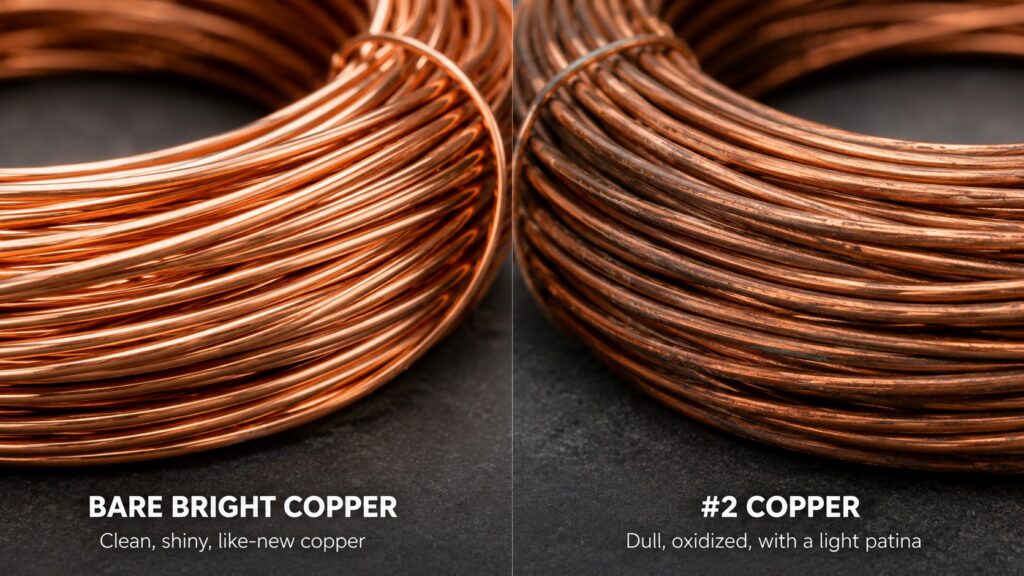
Bare Bright copper. Uncoated, unalloyed copper wire with no insulation, no solder, and no visible oxidation. It’s shiny, orange-pink, and usually comes from stripped electrical offcuts, new-build wiring, or clean telecom cable cores. It’s the top grade because a buyer can send it straight to a smelter with no further processing. If you have wire like this, keep it separate from everything else.
#1 copper. Similar purity to Bare Bright, but it might show a light patina or some minor surface oxidation. Still uninsulated, still clean of paint or solder. Slightly below Bare Bright in value, but not by much.
#2 copper. Uninsulated copper wire that’s more visibly oxidized, has mixed diameters, or shows some light soldering. Still worth selling, just at a further discount from #1.
Insulated Copper Wire (ICW). This is where most household and office cable falls: PVC or rubber-coated wire where the copper is still sitting inside its jacket. Because a buyer has to strip or granulate it to recover the copper, it’s priced lower per kilogram than any bare grade. How much copper you actually get back also depends on how thick the cable is and how much insulation surrounds it.
| Grade | Condition | Relative Value |
|---|---|---|
| Bare Bright | Clean, uncoated, no oxidation | Highest |
| #1 Copper | Clean, uncoated, slight patina allowed | High |
| #2 Copper | Uninsulated, oxidized or mixed diameter | Moderate |
| Insulated Copper Wire (ICW) | Still coated in plastic or rubber | Lowest per kg |
As a rough sense of scale, Singapore market pricing in 2026 has generally put Bare Bright somewhere in the high single digits per kilogram, with ICW running several dollars lower depending on the coating and how much copper it recovers. These numbers move daily with the metals market, so treat any figure you see online, including this one, as a ballpark rather than a quote. The only way to know what your specific load is worth is to have it weighed and graded by whoever’s collecting it.
Sell at Karung-guni: https://karung-guni.com/karung-guni-sell/
Does It Matter If the Wire Is Insulated?
Yes, and this is probably the single biggest factor in your final payout. Insulated wire pays less per kilogram than bare wire because the buyer still has to deal with the coating. That doesn’t mean insulated wire is a bad deal, it just means you’re being paid for raw cable rather than processed copper.
Some sellers strip the insulation themselves before selling, since bare wire fetches more. Whether that’s worth your time depends on how much wire you have and how thick it is. Stripping a handful of thin household wire for a small price bump usually isn’t worth the effort. Stripping a large coil of thick-gauge cable can genuinely move you into a better pricing bracket. One thing worth flagging: don’t burn the insulation off to speed things up. Open burning isn’t allowed in Singapore, it’s a real fire and fume hazard, and burnt copper actually gets downgraded by buyers anyway because the scorching affects the metal underneath. If you’re not sure whether stripping is worth it for your load, ask a dealer for both rates, as-is and stripped, before you spend the time.
What Actually Affects Your Payout
Before you contact anyone, it helps to know what a buyer is looking at when they assess your wire:
- Insulation status: bare wire pays more per kilogram than insulated wire of the same underlying copper
- Wire gauge and thickness: thicker wire generally recovers more copper and grades higher
- Contamination: paint, tape, solder, connectors, or attached fittings can drop your wire down a grade
- Mixed metals: copper mixed with steel, aluminium, or brass fittings often gets priced at the lowest metal present unless separated
- Oxidation: a green or heavily discoloured surface signals a lower grade than shiny, fresh copper
- Quantity: larger, well-sorted loads are easier for a dealer to process and can sometimes get better per-unit pricing than small mixed bags
None of this needs special equipment to check yourself. A quick visual sort at home before collection is usually enough to avoid the most common payout-killing mistakes.
How to Sell Copper Wire Scrap to Karung Guni Singapore
Karung Guni Singapore, run by Infinity Fair Trading, keeps this fairly simple, built around the idea that you shouldn’t need to leave your home or office to get paid for scrap.
Here’s how it works:
- List your item. On karung-guni.com, fill in a short form describing what you’re selling, including the item type, a description, and photos of your copper wire.
- Get a quote. Based on what you’ve submitted, you’ll get a quote for your scrap.
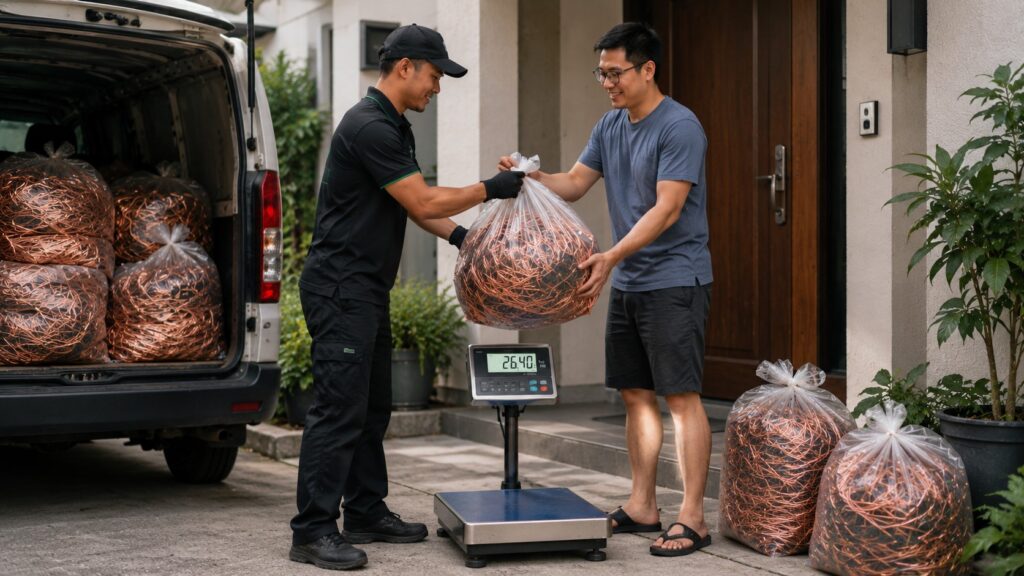
- Schedule a collection. Pick a time that works for you. Karung Guni Singapore offers free doorstep collection for homes, offices, hotels, and schools, so you don’t need to arrange your own transport.
- Get paid on the spot. Payment happens immediately at collection.
If you’d rather skip the form and just talk to someone, WhatsApp is the fastest route. Karung Guni Singapore lists a typical response time of around two hours during business hours, which is useful if you want a same-day answer on whether your load is worth collecting.
Copper and aluminium wiring fall under their scrap metal collection category, alongside cables, motors, and other electrical and industrial items, so you’re not trying to squeeze a specialist material into a general junk-removal service. If you’re clearing out a larger volume of cabling, say from an office refit or a decommissioned server room, it’s worth reading through how data center decommissioning scrap collection works too, since copper-rich cabling and networking gear are often part of the same clearout.
Sell at Karung-guni: https://karung-guni.com/karung-guni-sell/
Prepping Your Wire Before Collection
A bit of prep goes a long way toward a smooth transaction and a fair quote. Before your collection is scheduled:
- Sort bare wire and insulated wire into separate piles or bags. Mixing them usually means the whole lot gets priced at the lower grade.
- Remove any obviously non-metal attachments, like plastic clips, tape, or connectors, where it’s quick and easy to do so.
- Get a rough estimate of total weight if you can. This isn’t for pricing purposes, the dealer will weigh it properly, but it helps you decide whether a collection is worth scheduling now or worth waiting until you’ve got more.
- Make sure the collection area is accessible. If your wire is stored somewhere awkward, like a deep storeroom or behind other clutter, moving it closer to your entrance beforehand saves time for everyone.
Common Mistakes That Cost People Money
A few patterns come up again and again with first-time sellers:
Selling to unlicensed roadside buyers. Singapore’s scrap metal collection industry is overseen by the National Environment Agency (NEA), and legitimate commercial collectors typically operate under licensing requirements tied to waste collection. An unlicensed operator with no fixed premises and no way to verify their pricing method is a much bigger gamble than it looks. If you’re ever unsure, it’s fair to ask a dealer how they’re registered or how their pricing works before you commit to a sale.
Mixing wire types. As mentioned above, one bag of mixed bare and insulated wire usually gets priced at whichever grade drags the average down, not the average of the two.
Guessing your own weight. It’s tempting to eyeball a bag and assume you know what it weighs, but let the dealer’s scale do the work. Estimating for your own planning is fine, treating that estimate as the final number is how people end up feeling shortchanged.
Not asking how the quote was calculated. A transparent dealer should be able to explain, even briefly, why your quote landed where it did, what grade they assessed your wire as, and roughly how that maps to current market pricing. If a buyer can’t or won’t explain that, it’s a fair signal to get a second opinion.
A Quick Legitimacy Checklist
Whichever dealer you use, whether it’s Karung Guni Singapore or someone else, it’s worth running through a short checklist before handing anything over:
- Do they have a real, findable business presence, not just a phone number on a flyer?
- Can they explain how your quote or price was determined?
- Do they provide some form of documentation or confirmation for the transaction?
- Are they upfront that prices fluctuate with the market rather than promising a fixed rate no matter what?
This isn’t about being suspicious for the sake of it. It’s the same due diligence you’d apply to any cash transaction with a business you haven’t dealt with before.
Is It Legal to Sell Scrap Copper in Singapore?
Individuals selling scrap metal they personally own generally aren’t the ones who need a licence. The licensing requirements under NEA are aimed at the commercial collectors and dealers who pick up waste from the public, not at a homeowner clearing out a storeroom. That said, if you’re selling in bulk regularly, or on behalf of a business, it’s worth confirming your specific situation directly with NEA rather than going off a general summary, since the requirements get fairly detailed depending on your situation.
Getting Your Cash Today
If you’ve read this far, you probably already have a decent idea of what you’re sitting on. Bare, clean wire is worth sorting out and highlighting separately. Insulated cable is still worth selling, just at a lower per-kilogram rate, and stripping it yourself is really only worth the effort for large, thick-gauge loads.
From there, it’s a matter of getting an accurate quote and arranging a pickup that doesn’t eat up your day. You can list your copper wire on karung-guni.com to get a quote, or reach out over WhatsApp if you’d rather talk it through first. If you’d like to know more about how the company works before you commit, the about page has more background, and the contact page has every way to reach the team. Either way, doorstep collection and on-the-spot payment mean the whole thing can be done without you ever leaving your home or office.
Sell at Karung-guni: https://karung-guni.com/karung-guni-sell/
No Comments