


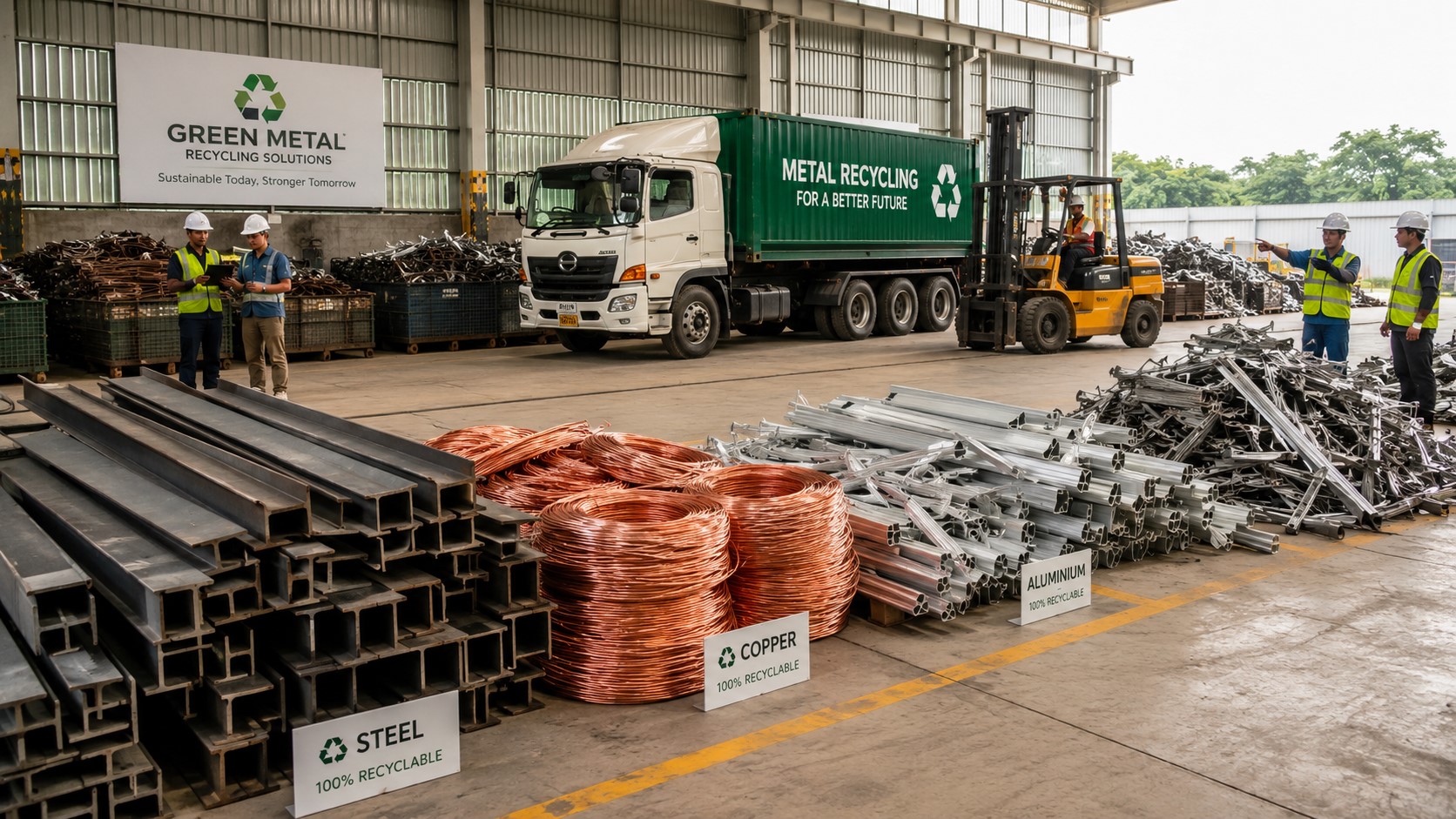
06 Aug Complete Industrial Metal Recycling Solutions in Singapore: What Factories Need to Know
If your factory or plant generates metal scrap regularly, you already know the problem. Scrap piles up fast. It takes up floor space. And if you’re not handling it properly, you’re either losing money or creating a compliance headache.
Industrial metal recycling in Singapore is not complicated. But a lot of businesses don’t know exactly what counts as recyclable scrap, how collection works at scale, or what they should do before a truck shows up. This guide covers all of it, step by step.
What Counts as Industrial Metal Scrap
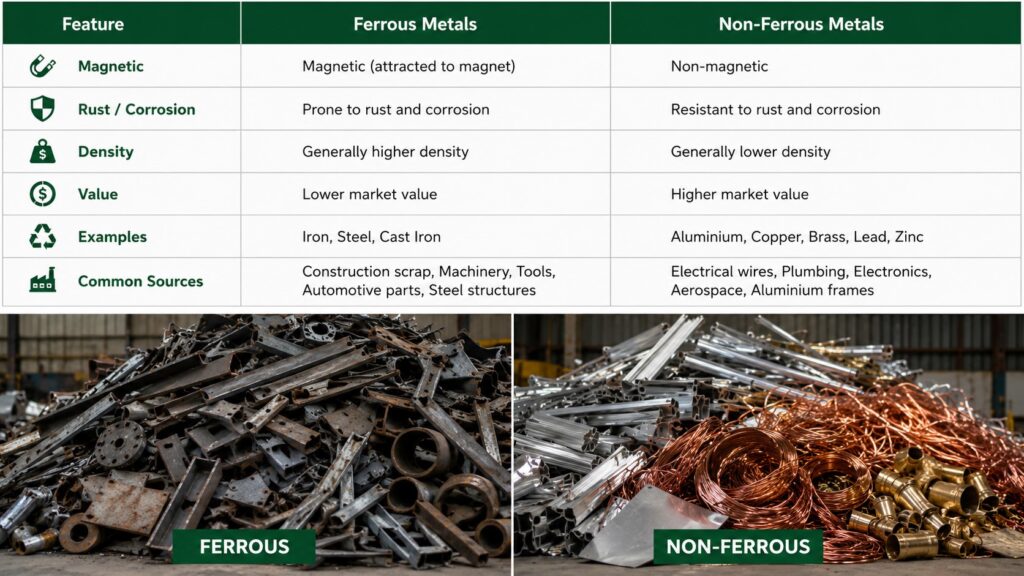
Industrial metal scrap falls into two main groups: ferrous and non-ferrous.
Ferrous metals contain iron. Steel, cast iron, and mild iron all fall into this category. You’ll find ferrous scrap in structural beams, machinery frames, storage racks, vehicle parts, and general fabrication offcuts.
Non-ferrous metals don’t contain iron. Copper, aluminium, brass, stainless steel, and lead are the most common. These tend to come from electrical wiring, motor windings, heat exchangers, pipes, valves, and food-grade or chemical processing equipment.
Here’s a quick reference:
| Metal Type | Category | Common Industrial Sources |
|---|---|---|
| Mild steel | Ferrous | Structural frames, beams, racks |
| Cast iron | Ferrous | Machine bases, engine blocks |
| Stainless steel | Non-ferrous | Food equipment, tanks, pipework |
| Copper | Non-ferrous | Electrical wiring, motor windings, bus bars |
| Aluminium | Non-ferrous | Extrusions, panels, heat sinks |
| Brass | Non-ferrous | Valves, fittings, connectors |
| Lead | Non-ferrous | Batteries, cable sheathing |
Why does the distinction matter? Because non-ferrous metals generally carry higher scrap value than ferrous metals. And the way they’re assessed during collection is different. A load of clean copper cable will be valued differently from a mixed pile of steel and copper mixed together.
If you’re clearing out a factory floor, a machine shop, or an engineering workshop, the chances are good that you have both types on hand.
Why Scrap Metal Has Real Cash Value
A lot of factories treat old metal as a disposal problem. It’s actually the opposite. Metal retains value even after it’s been used, cut, bent, or broken.
Scrap buyers purchase metal by weight and resell it to smelters and recyclers. The smelters melt it down and turn it into new raw material. That material goes back into manufacturing. The cycle keeps going.
For a factory, this means the scrap sitting on your floor is not waste. It’s inventory you haven’t collected payment for yet.
The amount you get depends on several things: the type of metal, the condition of the load, how clean or contaminated it is, and where commodity prices are sitting at the time of collection. Prices move with global markets, so there’s no single fixed rate to quote here. What you can count on is that heavier, cleaner, better-sorted loads return more than mixed or contaminated ones.
Singapore’s Waste Management Framework and Why It Matters
Singapore takes waste management seriously. The National Environment Agency (NEA) regulates how industrial waste, including scrap metal, is handled and disposed of.
The Resource Sustainability Act (RSA) sets out obligations for waste generators in the industrial and commercial sector. Under this framework, businesses that produce large volumes of waste are expected to manage it responsibly. Working with a legitimate scrap collector, rather than simply dumping materials, is part of meeting that expectation.
This isn’t just a compliance tick-box. It also means the materials you sell for scrap are properly processed rather than ending up in landfill. Singapore’s overall goal is to reduce the amount of waste sent to Semakau Landfill, which has a limited lifespan. Industrial recycling, including metal scrap, is part of that picture.
If your facility generates significant volumes of scrap, it’s worth understanding where your materials go after collection and ensuring you’re working with a responsible buyer.
How Industrial Scrap Collection Actually Works
Here’s what the process looks like from start to finish.
Step 1: You make contact. Reach out to describe what you have. Type of metal, rough volume, and your location. This helps the collector assess whether a visit makes sense and what equipment they’ll need.
Step 2: Assessment and scheduling. For larger loads, the collector may want to visit first or ask for photos. Once they have a picture of what’s there, you agree on a pickup date and time. Industrial collections usually require a lorry and sometimes a forklift or crane for heavy pieces.
Step 3: Collection. The team arrives, loads the scrap, and handles the heavy lifting. If you’re in a JTC industrial estate or a building with restricted access, flag this during scheduling so the right vehicle and equipment can be arranged.
Step 4: On-site weighing. Scrap is weighed at your site or at the buyer’s yard, depending on the volume and arrangement. The weight is the basis for your payment.
Step 5: Payment. Payment is made based on weight and material type. Keep a record of what was collected, the weight, and the rate agreed.
The whole process is designed around your operations, not the other way around. A good industrial scrap collector works around your production schedule so the collection doesn’t disrupt your floor.
For a general overview of how scrap collection works across different job sizes, this guide to karung guni services in Singapore is a useful starting point.
What to Prepare Before Collection Day
A bit of preparation before the truck arrives makes the whole process faster and can improve your payout.
Separate metals by type where possible. You don’t need to be perfect. But if you can keep copper separate from steel, and stainless steel separate from mild steel, the weighing is more accurate and the assessment is cleaner.
Remove non-metal attachments where practical. Rubber fittings, plastic insulation, and wooden pallets attached to metal reduce the effective metal weight. Strip what you can.
Stack or consolidate loose scrap. Loose offcuts scattered across a floor take longer to load. Stack them in cages, bins, or on pallets if you have them.
Check access for the collection vehicle. Can a lorry get to your loading bay? Is there clearance for a crane or forklift if needed? Confirm this before collection day, not during it.
Estimate your volume. You don’t need an exact figure. A rough idea — one tonne, five tonnes, 20 tonnes — helps the collector send the right-sized vehicle and team.
Know what you have. Mixed loads are fine, but if you know you have a significant quantity of a specific metal (say, 200 kg of copper cable or a pile of aluminium extrusions), mention it upfront. It helps the buyer assess the load more accurately.
How Scrap Pricing Works
There’s no fixed price list for scrap metal. Prices fluctuate with global commodity markets, and they can move week to week.
A few things affect what you get for a specific load:
Metal type. Non-ferrous metals like copper and aluminium generally fetch more per kilogram than ferrous metals like mild steel or cast iron. Stainless steel sits somewhere in between depending on grade.
Cleanliness of the scrap. Clean, dry, uncontaminated scrap is worth more. Copper wire still inside thick PVC insulation is worth less per kilogram than stripped bare copper, because the insulation is dead weight that the buyer has to deal with.
Mixed versus sorted loads. A sorted load of one metal type is easier to assess and price. A mixed load requires the buyer to do more work to separate and evaluate, which typically affects the rate.
Volume. Larger loads are generally more practical to collect and may reflect better rates. Small quantities may be less cost-effective for a full industrial pickup.
The honest answer is that you won’t know the exact rate until you talk to the buyer. What you can do is be ready to describe your load clearly so the quote is accurate.
Common Mistakes Industrial Businesses Make
These come up repeatedly, and they all cost money or cause problems.
Treating non-ferrous scrap as general waste. Copper, aluminium, and brass going into a skip or a general waste bin is money thrown away. These metals have real scrap value. Separate them before disposal.
Not stripping copper cable before collection. Insulated copper cable is valued on the copper content, not the total weight. Thick PVC insulation is heavy. If you can strip the insulation off, or if you can identify how much of the weight is copper versus jacket, you’ll get a better-informed quote.
Mixing stainless steel with mild steel. Stainless steel has a higher scrap value than mild steel. If they’re mixed together, the whole load may be assessed at the lower rate. Keep them apart.
Letting scrap accumulate until it becomes a safety issue. Scrap on a factory floor creates trip hazards, fire risks, and access problems. Regular clearances are easier to manage than a massive one-off job every few years.
Assuming small quantities aren’t worth it. For residential-scale scrapping, small amounts may not warrant a collection visit. But industrial facilities often have more scrap than they realise once they do a proper inventory. Even off-cuts and swarf from machining operations add up quickly.
Not keeping a record of what was cleared. For your own accounts and for any compliance purposes, keep a note of what was collected, when, how much it weighed, and who collected it.
Is This the Same as a Regular Karung Guni Pickup?
No. There’s a meaningful difference between a residential karung guni call and an industrial scrap collection.
A residential pickup handles small quantities: old appliances, copper pots, newspapers, a few kilograms of metal here and there. The collector typically arrives with a small lorry and handles things by hand.
Industrial scrap collection is a different operation. You’re talking about tonnes, not kilograms. The loads may include heavy machinery parts, large structural steel, coils of cable, or bulk aluminium. The vehicles are bigger. The team is larger. The weighing equipment is industrial-grade.
The pricing model is also different. Residential pickups are often informal. Industrial collections are weight-based and typically involve a clear record of what was taken.
If your facility also needs to deal with electronic equipment during a clearance, such as old servers, office equipment, or IT assets, Karung Guni Singapore handles those too. See the office e-waste collection and data center decommissioning pages for how that works separately from metal scrap collection.
How to Get Started
The first step is simple. Contact Karung Guni Singapore and describe what you have.
Tell them the type of metal, a rough estimate of the volume, your location, and whether there are any access constraints at your site. From there, they’ll work out the logistics and come back to you with next steps.
You can reach the team on WhatsApp at wa.me/6590577637 for a fast response, or use the contact page to send an enquiry. If you want to understand more about the full range of materials and services before making contact, the sell page is a good place to start.
Industrial scrap collection works best when it’s planned, not reactive. If your facility generates metal scrap regularly, setting up a scheduled clearance arrangement is more efficient than calling each time the pile gets out of hand.
Metal scrap is not a waste management problem. It’s a recoverable asset. The factories that treat it that way clear their floors faster, stay compliant, and get paid for material they would otherwise lose.
Karung Guni Singapore is operated by Infinity Fair Trading, based at City Warehouse, Kaki Bukit Road, Singapore. They handle bulk industrial and commercial scrap collection across Singapore.
No Comments