


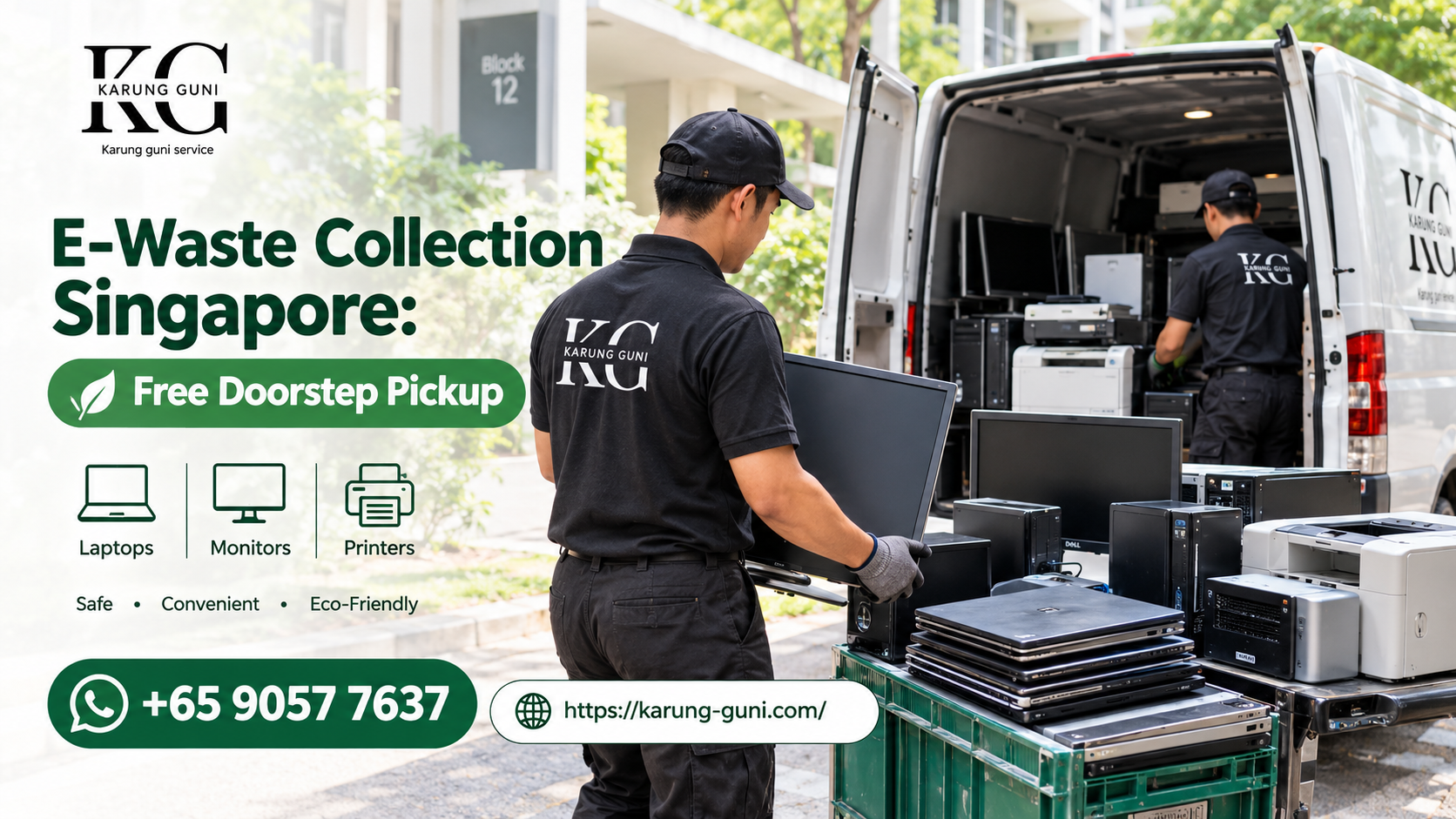
03 Oct E-Waste Collection in Singapore: How to Get Rid of Old Electronics the Right Way
You have a dead laptop in the cupboard, a box of old cables under the bed, or ten office printers nobody wants. You search “e-waste collection Singapore” because you want it gone, and you’d like to do it properly. Maybe get a bit of cash back too.
This guide covers what your real options are, which one fits your situation, what to prepare, and the mistakes that cost people time and money. If you already know what you have, you can list your items here and get a quote.
What counts as e-waste?
E-waste is anything with a plug, battery or circuit board that no longer works or that you no longer use. In Singapore homes and offices, the usual list looks like this:
- Laptops, desktop computers and monitors
- Phones, tablets and chargers
- Printers and scanners
- TVs, amplifiers, hi-fi sets and DVD players
- Gaming consoles and accessories
- Fridges, washing machines and fans
- Servers, switches, hard disks and power supplies
- Cables, wiring and small motors
These items contain metals and parts that can be reused or recovered. They also contain things that should not end up in a normal rubbish chute, like batteries and circuit boards. That is why throwing them in the bin is a bad idea.
Your main options for e-waste collection in Singapore
There is no single “best” way. It depends on what you have, how much of it, and whether you care about being paid.
1. Public e-waste bins and collection drives
Singapore has a national program for household e-waste under the Extended Producer Responsibility (EPR) scheme. ALBA E-waste Smart Recycling has been appointed as the operator, and bins are placed in public areas like town centres, shopping malls, community centres and supermarkets. The number of collection points has tripled over the years, and the 1,000th point has already been launched.
This works well for small things you can carry: a phone, a few cables, a small appliance. It costs nothing. The downside is that you do the carrying, and you get no payment. Bulky or large quantities are awkward.
2. Retailer take-back
Under the EPR scheme, retailers of consumer electronics offer free replacement services for old products, and larger stores must provide an in-store collection point. If you are buying a new fridge or TV, ask the shop to take the old one away. It is convenient, but only when you are buying something new.
3. Town council bulky waste removal
Town councils across Singapore also offer bulky waste removal services. This is handy for one big item, but you usually have to book a slot and wait for it.
4. A karung guni or e-waste buyer who collects from you
This is the best fit when you have a lot of items, heavy items, or items that still have value. A collector comes to your door, takes everything in one trip, and can pay you for items that have resale or scrap value. For offices, schools and hotels, this is usually the only option that makes sense, because nobody wants to carry 40 monitors to a bin.
Karung Guni Singapore offers free doorstep collection for homes, offices, hotels and schools, and pays on the spot when your items have value. We are at City Warehouse #04-1, 5 Kaki Bukit Road, Singapore 417839.
Which option should you pick?
Here is a simple way to decide.
| Your situation | Best option |
|---|---|
| One or two small items (phone, charger) | Public e-waste bin |
| Buying a new TV or fridge | Ask the retailer to take the old one |
| One bulky item, no rush | Town council bulky waste service |
| A room full of old electronics | Doorstep collection by a karung guni |
| Office clear-out or IT refresh | Doorstep collection, ideally with data wiping |
| Servers, copper cables, industrial gear | Specialist buyer who pays for value |
If you are not sure, send us a photo on WhatsApp and we will tell you straight whether it is worth collecting.
What you can actually get paid for
Not everything is worth money, and anyone who promises otherwise is not being honest. Roughly, it breaks down like this:
Often has value: working or repairable laptops, servers, networking gear, hard disks, power supplies, copper wiring, scrap metal, and some audio equipment.
Sometimes has value: desktop computers, gaming consoles, amplifiers, and newer appliances. Age, condition and demand decide it.
Usually little or no value: old CRT TVs, broken small appliances, mixed boxes of cables with no copper content. These are still worth recycling properly, but do not expect cash.
May cost a fee: large furniture and some bulky items. Karung Guni lists furniture disposal as a paid service because of the labour and transport involved.
Prices change with the market, especially for metals. For example, the price you get for copper cable depends on how clean it is and whether it still has insulation. We wrote a full guide on that: selling copper wire scrap in Singapore.
Common mistakes people make
1. Forgetting about the data. A laptop or hard disk that sits in a cupboard still holds your emails, photos and passwords. Before you hand over any device, back up what you need and wipe it. For offices, this is not optional. Customer data on a discarded drive can become a legal problem. Read our guide on secure hard disk destruction if you handle company data.
2. Stripping parts before selling. Some people pull out the RAM or hard disk thinking it is worth more separately. Usually a complete unit gets a better offer than a gutted one.
3. Letting items pile up for years. Old lithium batteries swell and can become a fire risk. Old UPS units are a common example. If you have one, see how to find reliable UPS scrap buyers.
4. Mixing everything into one bag. Sort by type first. Laptops in one pile, cables in another, small appliances in another. It makes quoting faster and usually gets you a fairer price.
5. Using the first person who answers. Ask who will actually collect, where the items go, and whether they can explain what happens to them. A good collector answers clearly without getting vague. Also be careful with anyone who asks for payment upfront to “reserve” a pickup.
6. Skipping photos. Quotes without photos are guesses. Three or four clear photos save a lot of back and forth.
Tips for offices and businesses
A home clear-out is simple. A business clear-out has more moving parts. A few things that help:
- Make a rough list first. Even a basic count (for example, 25 laptops, 12 monitors, 6 printers) helps a lot with quoting.
- Plan access. Check lift size, loading bay hours and building rules before the collection day.
- Ask about data. If devices hold company data, decide whether you need wiping or physical destruction, and ask for a record of it.
- Keep your asset list updated. Finance and IT will thank you at audit time.
- Batch your disposals. Doing it once a quarter beats ten small pickups.
We have detailed guides for common business cases:
- Office e-waste collection
- Selling spoilt computers in bulk
- Corporate laptop recycling
- Bulk printer disposal
- Selling used enterprise servers
- Data center decommissioning collection
A real-world example
Here is a typical scenario we see. A small office is moving to a new unit. In the storeroom they find 18 old desktop computers, a pile of monitors, four printers and a box of network cables. The office manager has two choices: spend a weekend arranging bins and trips, or book one pickup.
With a doorstep collection, they send photos, get a quote, pick a time, and the team loads everything in one visit. Items with value are paid for on the spot. The rest is taken away for recycling. The manager gets the storeroom back and a clear record of what left the building.
That is the point of a good collection service. It takes the effort off you.
How Karung Guni Singapore collection works
- Tell us what you have. Use the form on our sell page or message us on WhatsApp. Add a few photos and a short description.
- Get a quote. We usually reply within 2 hours during business hours.
- Pick a time. Approved collections are scheduled to suit you.
- We come to you. Homes, offices, hotels and schools are all covered.
- Get paid. If your items have value, you are paid at collection.
Want to know more about who we are first? See our About page.
Frequently asked questions
Is e-waste collection free in Singapore? Public bins and many retailer take-back options are free. Private doorstep collection is often free when the items have value, but bulky or low-value loads may carry a fee. Always ask for the terms before booking.
Can I sell my old laptop to a karung guni? Yes. Working and repairable laptops often have resale value. Condition, age and specs decide the price. Wipe your data first.
What happens to my e-waste after collection? Items with value are reused or sold on. The rest goes to recycling, where metals and materials are recovered. Ask any collector where your items go. They should be able to tell you.
Do you collect from offices and schools? Yes. We collect from homes, offices, hotels and schools.
Can you take furniture too? Yes, but furniture disposal comes with a fee. We also take scrap metal, used clothing and fabrics, audio equipment and more.
Do I need to take my devices apart? No. Leave them whole. Just remove personal data and any accessories you want to keep.
How fast can you collect? It depends on your location and our schedule. Send us a message and we will give you a clear time.
Is the NEA e-waste program still the same? Programs and operators can change. ALBA’s original five-year term as operator ran to June 2026, so check the NEA website for the latest bins, drives and rules before you rely on a specific scheme.
Ready to clear your e-waste?
Do not let old electronics sit and collect dust. Tell us what you have and we will tell you what it is worth.
WhatsApp: +65 9057 7637 Address: City Warehouse #04-1, 5 Kaki Bukit Road, Singapore 417839 Request a quote: Sell at Karung Guni or get in touch
No Comments