


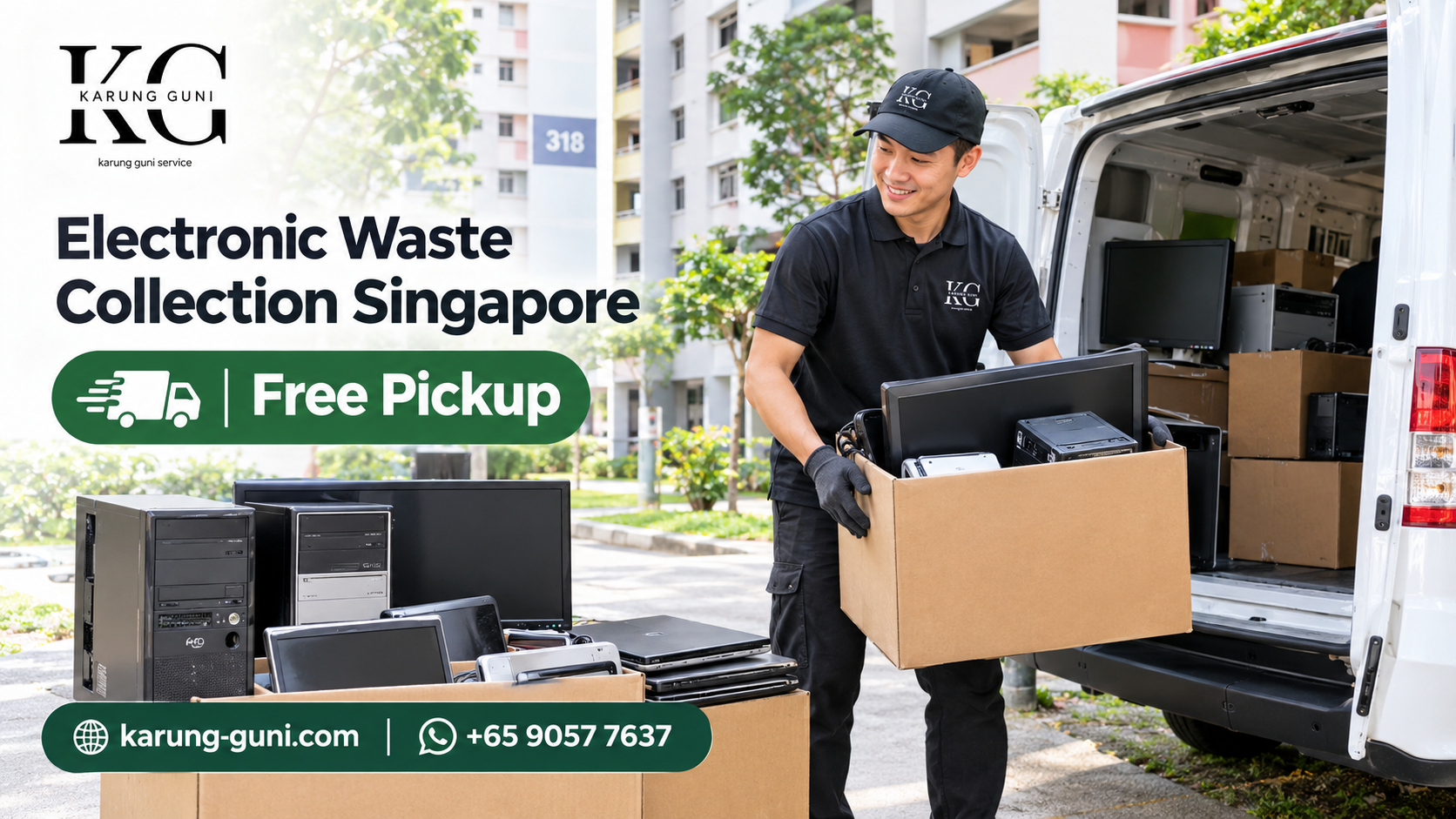
30 Sep Electronic Waste Collection in Singapore: Your Options, Costs, and How to Choose
You have a dead laptop in the drawer, a TV that no longer turns on, and a printer you keep meaning to deal with. You know they should not go in the normal bin. But where do they go, and who will actually pick them up?
This guide walks through every way to get rid of e-waste in Singapore, what each one costs in time and money, and how to pick the right one for your load. It also covers what to do before pickup so your data stays safe.
Why e-waste cannot go in the normal bin
The National Environment Agency (NEA) says e-waste should not be thrown away as general waste. It should be sent for proper treatment and recycling. Under Singapore’s regulated e-waste system, the items covered include computers and laptops, phones and tablets, printers, monitors, large appliances like fridges and washing machines, batteries, light bulbs and tubes, and electric mobility devices.
There are two simple reasons behind this. First, batteries and some parts can be harmful if they are burned or dumped. A damaged lithium battery can also start a fire inside a rubbish truck. Second, old electronics hold useful materials like copper, aluminium and plastic that can be recovered and used again.
The blue recycling bin is not the answer either. It is for paper, plastic, glass and metal packaging. Electronics need a proper e-waste route.
Your main options for e-waste collection in Singapore
| Option | Best for | Cost | The catch |
|---|---|---|---|
| Public e-waste bins | Phones, small gadgets, batteries, small ICT items | Free | Only items that fit through the bin opening |
| Retailer take-back | Replacing a big appliance | Free, one for one | Only when a store delivers a new item of the same type |
| Quarterly collection drives | Bulky items when you can wait | Free | Set dates, set estates, you must bring the items |
| ALBA doorstep collection | Households with large appliances | Fee applies for most items. NEA says large household appliances from homes are free since 1 January 2025 | You book through their system |
| ALBA depot drop-off | Anyone with a car | Free | Depot is at 20 Tuas Loop, far for many people |
| Private collector like Karung Guni | Bigger loads, offices, mixed items, items with resale or scrap value | Free doorstep collection, and you get paid when the items have value | Some items, like furniture, carry a fee, so ask before you book |
One note on timing. NEA’s pages show that ALBA’s five year term as the official scheme operator ran from 1 July 2021 to 30 June 2026. Before you plan a drop-off, check NEA’s e-waste page for the current operator, bin locations and collection drive dates.
When a private collector makes more sense
Public bins are great for a broken phone. They are not great for ten office monitors, a server rack or a fridge that will not fit in your car. A collector who comes to you makes sense when:
- You have a lot of items, or heavy ones.
- You are clearing an office, a shop, a school room or a hotel floor.
- You are moving out or renovating and have a deadline.
- Your items are mixed, for example old computers, cables and a bit of scrap metal.
- Some of it still works and might be worth money.
- You do not have a car, or you simply do not want to spend a Saturday driving to a depot.
What Karung Guni collects
We collect e-waste and other used items from homes, offices, hotels and schools. Here are the most common ones and where to read more:
- Computers and laptops: working or spoilt. See our page on selling spoilt computers in bulk.
- Printers: see bulk printer disposal.
- Fridges and washing machines: see old refrigerator disposal and selling a spoilt washing machine.
- Amplifiers and hi-fi sets: see what an old amplifier is worth.
- UPS units and power supplies: see UPS and power supply buyers.
- Network switches: see used network switches.
- Servers and racks: see selling used enterprise servers and server rack disposal.
- Also: TVs, gaming consoles, VCD and DVD players, electrical cables, and medical equipment.
Not sure if your item is on the list? Send us a photo and ask.
How a collection works
- Tell us what you have. Fill in the form on our sell page or send photos on WhatsApp. It takes about two minutes.
- Get a quote. We usually reply within 2 hours during business hours.
- Pick a time. We schedule the pickup around you.
- We come to your door. No need to carry anything to a car or a bin centre.
- Get paid on the spot for items that have value.
Before you hand anything over: a quick checklist
This is the part people skip, and it is the part that matters most.
- Back up what you need. Photos, contacts, documents. Once the device is gone, so is the data.
- Sign out of your accounts. Turn off Find My iPhone or Find My Device, and sign out of iCloud, Google and Microsoft accounts. A locked device is much harder to recycle or resell.
- Factory reset phones and tablets. On an iPhone, go to Settings, General, Transfer or Reset iPhone, then Erase All Content and Settings. On Android, the path is usually Settings, System, Reset options, then Erase all data. Menu names change a little between brands.
- Take out SIM cards and memory cards.
- Wipe laptops and desktops. A normal delete is not enough. Use the reset option in the operating system, or a proper wipe tool.
- Handle dead drives with care. If a hard drive will not power on but held work files, customer data or anything private, do not just hope for the best. Physical destruction is the safer route. Read more about hard disk destruction.
- Check the batteries. If a battery is swollen or leaking, do not charge it, and do not poke it. Keep it away from heat. For loose batteries, NEA advises taping the ends and sealing leaking ones in a leak-proof bag.
- Keep cables and chargers with the device. Copper cables have scrap value, and a complete set is easier to quote.
- Take a few photos and note the model. This makes the quote faster and more accurate.
Common mistakes to avoid
- Throwing e-waste in the general bin or the blue bin. It ends up in the wrong place, and batteries can cause fires.
- Skipping the data wipe. Old phones and laptops can hold banking apps, saved passwords and photos.
- Splitting one clear-out across five trips. A few items here, a few there. One pickup usually saves time and petrol.
- Not asking where the items go. A good collector can tell you plainly what happens to your items after pickup.
- Taking devices apart yourself. Opening a laptop or TV can damage a battery or hurt you, and it rarely adds enough value to be worth the risk.
- Waiting until the last week before a move-out or renovation. Book earlier and you get more choice on timing.
- Assuming broken means worthless. Spoilt computers, amplifiers, cables and appliances often still have scrap or parts value. Ask before you pay someone to take them.
If you are clearing out an office or business
Business clear-outs need a bit more planning, mostly because of data and paperwork. A simple approach:
- Make a list of what is going: item type, quantity and, for computers, serial numbers.
- Separate items that hold data from items that do not.
- Decide who signs off on the handover.
- Ask the collector how data-holding devices are handled.
We have separate guides for office e-waste collection, corporate laptop recycling, data centre decommissioning, and selling electronics in bulk. If you are a regular seller, our bulk electronics buyer page is a good place to start.
How to choose an e-waste collector
Whoever you pick, ask these questions first:
- Where do the items go after pickup? You want a clear answer about recycling, not a vague one.
- How do you handle data? Especially for laptops, phones, servers and hard drives.
- Will I know the price before you come? Ask about any fees for bulky or low value items, such as furniture.
- Is there a real address and a real person to talk to? You should be able to reach them on WhatsApp and know where the business is based.
- Do they explain how the pickup works? If the steps are unclear on the phone, they will be unclear on the day.
You can read about who we are on our about page. Our warehouse is at City Warehouse #04-1, 5 Kaki Bukit Road, Singapore 417839.
Frequently asked questions
Is e-waste collection free in Singapore?
It depends on the route. Public e-waste bins and retailer take-back are free. Some doorstep services charge a fee. With Karung Guni, the doorstep collection itself is free, and you are paid on the spot for items that have value. Some items, such as furniture, may carry a disposal fee, so ask when you send your list.
Can I sell broken electronics in Singapore?
Often, yes. Spoilt computers, amplifiers, UPS units, network gear and cables can still have parts or scrap value. Send photos and the model, and we will tell you what it is worth.
What can I do with a big item that does not fit in an e-waste bin?
You have three choices. Wait for a town council collection drive, use a doorstep service, or ask a private collector to pick it up. For fridges and washing machines, also check whether your retailer offers free one for one take-back when they deliver a new one.
Is my data safe when I give away an old laptop or phone?
Only if you make it safe. Back up, sign out, and reset or wipe the device before pickup. For drives that hold sensitive business data, ask about physical destruction.
Where do I put old batteries?
Use a battery bin or a general e-waste bin. NEA says to tape the ends of loose batteries first and to seal leaking ones in a leak-proof bag. Never throw them in the normal bin.
Ready for pickup?
Send us a list and a few photos. We will tell you what we can collect, when we can come, and what your items are worth.
- WhatsApp: +65 9057 7637
- Online form: List your items here
- Contact page: Get in touch
- Address: City Warehouse #04-1, 5 Kaki Bukit Road, Singapore 417839
No Comments